Bloody Ruminations
"Of all the written I love only that which he writes with his blood...for he who writes in blood does not want to be read, but to be learnt by heart." ~F. N.
Currently reading


Find your lost spaces.
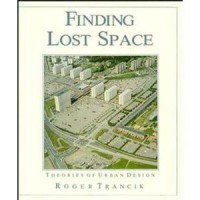
"Finding lost spaces: theories of urban design" is a classic, an old book on how to re-integrate the segregated open spaces from the urban fabric. It begins with the assumption that architecture cannot solve the problem of lost spaces and to solve them there must be a set of "New Rules" to order them all.
The book starts with a definition of lost spaces and their causes, and then blames it all on modernists and their attitude toward public space. It then presents three clear and distinct theories of urban space (which I found the most useful part of the book). the three theories being the figure-context theory (based on mass/space or positive/negative dichotomy of planning), the linkage theory (considering the activities and circulation of people in the public sphere of cities), and the place theory (representing cultural and social context). the last pages of the book are filled with a few case studies to illustrate Trancik's points, which you can skip after the cases of Boston and Washington D.C..
Overall the book is worth reading if you are a planner, or you work on the large-scale. I personally think that most lost spaces can be found with small, cute ignition of public and private sector coupled with a little architectural creativity and do not need a philosophical approach.

Career Match: Connecting Who You Are with What You'll Love to Do
 "Don't Read the Whole Book" makes an amazing tagline in these busy days. I skimmed through the book in an one hour sitting, the reason was one certain blogger's recommendation.
 It is usually noted that people with my MBTI profile, "INTj"s -what this book calls Introvert Blue/Golds- are more interested in typing people than other types; maybe because we want people to make sense and the theory evolved by Jung, Myers-Briggs and Keirsey provides the intellectual foundation for it. So naturally, I would enjoy any book that is entangled with ideas regarding types.
This book's amazing part for me was its introduction to typing, where the author shares an imaginary visit of a hypothetical company where the organization's structural system is developed based on MBTI types and Keirsey's four temperaments. It is an inspiring read and makes you want quit your job and build the company that would fulfill that vision, if you know what I mean.
Yet the book soon falls in abysses of bore and you can predict the content of all the pages to come, specially if you have a base knowledge of MBTI. There is no further plot twists, and the book end right there, in the abysses of bore. Of course you can always listen to the authors initial advice and "don't Read the Whole Book".

SPIN-selling
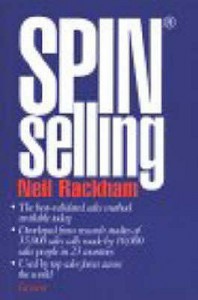 The book is about how selling works, but first let me ask you a question. Are you satisfied with your selling skills? Can you tell how do your selling skills destroy your ventures, your career, and your future? did you knew that 87 percent of failures in any business are linked to a lackage of selling skills? How would you contribute to the world, your family and yourself if you could sell ANYTHING to ANYBODY? ...
that's how science works. scientists observe a natural phenomena in practice, model it, test their models and publish their theory to the paradigm-addicted community. the community will resist it initially but as anomalies grow, they shift their thinking and adopt the new paradigm. and here is the first scientific paradigm on selling. it is the SPIN theory.
the SPIN theory is nothing but a combination of active listening and the old Hurt-and-Rescue principle revisited. Rackham did extensive researches on top salespeople in action, and modeled their behavior in a linear sequence. one that starts with "opening a call" and ends in "obtaining commitment", and goes through the all-important stage of investigation, in which by asking Situation, Problem, Implication and Need-payoff (thus SPIN) question the seller develops customers implied needs into explicit needs and creates value in their mind, and a demonstrating capability stage in which he shows how the product/service meets the customers expressed explicit needs.
Certainly there is more to sales than just asking questions; but Rackham's classic is yet the most reliable source on selling, and one that I recommend every person to read. if nothing, it will turn people into better listeners and that is good.

The First 20 Hours: How to Learn Anything...Fast
 An interesting read, but not as useful as it proposes. The book is the personal journey of the author(who much like me is a learning junkie) into realms of self-development and skill-acquisition. it begins with an manifesto against our perception of 10000 hours rule and presents a concise review of the principles and tools in rapid skill-acquisition, then dives in to illustrate those principles in acquiring several skills he had thought he could never find time to master.
 Read it if you find it interesting, but you can get all you need to know about the ideas in the book from the author TEDx talk: http://tedxtalks.ted.com/video/The-First-20-Hours-How-to-Learn

Willpower: Rediscovering the Greatest Human Strength
 “When psychologists isolate the personal qualities that predict positive outcomes in life, they consistently find two traits: intelligence and self-control.” Baumeister and Tierney, coauthors of “Rediscovering The greatest human strength: Willpower” second that.” So far researchers still haven’t learned how to permanently increase intelligence. But they have discovered, or at least rediscovered, how to improve self-control.”
“How one can improve self-control?” Is the question the book has tried to answer. And the answer would be an experimental/scientific one regarding the history of what they come to call it “Self-Regulation”. It couldn’t be a simple/straight one indeed. The book looks just like a perfect report on how to discover “how to improve self-control”. It takes a journey at least. This is the advantage and weakness of the book at the same time. It does coop in the reader – so forgetting it would be hard- and it makes reading the book so boring.

Powerful Sleep: Secrets of the Inner Sleep Clock
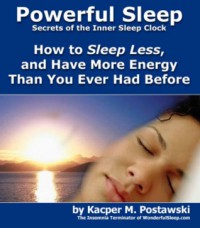 A practical and concise book on understanding sleep system and a guide to rest; it will change one's whole lifestyle on reading for the first time.

A Place of My Own: The Education of an Amateur Builder
 The book is the report of an inquiry in the province of architecture, and how to architect; To show if it roots in the nature of man, or is a result of his needs. Is it all about the material and body, or it is about mind and soul too? The book worth reading though is a little fargoing.
